
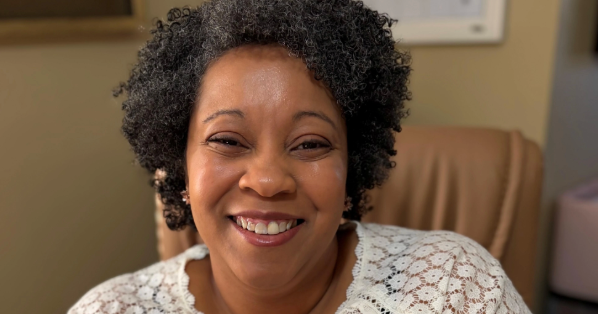
For more than three decades, Dawn Jemison lived with a relentless, stabbing pain that radiated from her ribcage to her pelvis. What began as vague discomfort during middle school grew into a lifelong struggle that saw the Fort Wayne, Indiana, resident cycle through countless specialists and diagnostic tests. For years, medical professionals dismissed her suffering as typical puberty or suggested it was psychological. Some told her she was merely seeking drugs, while others offered misguided advice, suggesting that having a baby might regulate her system. By age 43, the physical and emotional toll became unbearable, leading Jemison to schedule a total hysterectomy in early 2025 as a last resort to stop the agony.
The trajectory of her life shifted entirely due to a random occurrence at her job as a restaurant server. While attending to a group of healthcare representatives and doctors in a private dining room, Jemison overheard a presentation describing a specific patient case. As the speaker detailed how a pelvic vein stent had relieved another woman’s symptoms, Jemison realized the description mirrored her own experience perfectly. Driven by hope, she approached the team after their meal and connected with interventional cardiologist Dr. Abigail Qin Nelson, prompting Jemison to postpone her upcoming surgery for further investigation.
Dr. Qin Nelson suspected Jemison suffered from pelvic congestion syndrome, a difficult to diagnose condition where blood pools in the pelvic area due to venous blockages rather than arterial issues. A subsequent venogram revealed significant compressions in Jemison’s iliac vein—one blocked by 76 percent and another by 52 percent. For Jemison, the diagnosis provided an immediate sense of validation after twenty years of being doubted by the medical community. It was finally proof that she hadn’t been imagining the pain or fabricating her symptoms for attention.
The resolution came through two minimally invasive procedures involving the placement of stents to reopen the blocked veins and allow blood to flow normally toward the heart again. The results were transformative; within a short period, Jemison reported that her daily pain levels dropped to zero. Reflecting on the ordeal a year later, she noted that moving forward with the hysterectomy likely wouldn’t have solved her problem at all. Today, instead of spending her days managing debilitating pain in bed, she is rediscovering simple joys like walking in the park and gardening without fear_of collapse_or discomfort_.